There is a particular kind of book that stops you when you pick it up.
The cover feels substantial. The texture is rich under your hand, woven or grained, calm and classic. And then there is the image, set in a clean, recessed frame on the front, like a small window into the story within.
That image is called a tip-on cover image. Some creators call it a mounted image, a tipped-on cover image or photo, or an inset cover image. Whatever the name, it is one of the most beautiful finishing options we offer at Vervante, and one of the most overlooked.
What a Tip-On Photo or Image Cover Actually Is
A tip-on cover includes a printed image that is film-laminated for protection and then bonded directly onto the front cover of a hardcover book.
At Vervante, we deboss the cover first, creating a slight recess sized exactly to the image. It is then carefully placed into that debossed area and glued to the cover material.
The result is an image that sits flush with the surrounding cover, framed by the linen or faux leather. It feels intentional. It feels finished. It feels like it was always meant to be there.
Why This Detail Matters
A hardcover book is already a statement. The weight, the rigidity, the substance of it all signal something different than a paperback or a digital file.
A tip-on cover takes that one step further. It introduces contrast: the matte texture of fabric or leather against the smooth, color-rich surface of an image. The eye catches that contrast immediately. The hand notices the difference in texture before the brain even processes it.
For creators who care about how their work shows up in the world, that small moment of contrast can be the difference between a book that looks nice and a book that feels meaningful.
Where Tip-On Covers Work Best
Tip-on image covers pair beautifully with our faux linen and faux leather hardcover books. The fabric or leather texture provides a calm, classic backdrop. The image becomes the focal point.
This combination works especially well for:
Memoirs and personal stories
Photography and coffee table books
Anniversary and commemorative editions
Signature and limited editions
Gift books and keepsakes
Family histories and legacy projects
High-end coaching workbooks and signature programs
If you are creating a book that someone will keep on a shelf for decades, this is the kind of finish that earns the shelf space.
Combining Tip-On Images With Other Finishing Details
A tip-on cover does not have to stand alone. Many of the most beautiful books we print combine it with several finishing details that work in concert:
Foil stamped titles, names, or logos in gold, silver, copper, or custom colors
Debossed elements around the title or below the image
Ribbon markers in a complementary color
Printed endpapers that echo the cover image
Dust jackets for an additional layer of polish
The image can be a single image, a softly bordered scene, an illustrated panel, or an original piece of artwork. Some creators use a photograph or image from inside the book. Others commission an illustration or use a piece tied to a personal story. The choice is yours, and we are happy to talk through what will reproduce best at the size and placement you have in mind.
Binding Compatibility
Tip-on covers can be added to hardcovers with PUR, Smyth-sewn, Wire-O, or metal spiral binding. That covers nearly every binding format we offer for hardcover books, so the cover treatment does not lock you into a specific binding choice.
A Note on Craft
Tip-on covers are not the fastest or the cheapest finishing option. They take more time, more handwork, and more attention than a printed case wrap. That is part of why they feel the way they feel.
Vervante has been printing for creators for 25 years. In that time, we have helped first-time authors turn a single dream of a book into something they could hold. We have watched creators print 25 copies, then 250, then 1,000. We have packaged signature editions for coaches and speakers who needed their book to feel like the centerpiece of a body of work.
A tip-on cover is one of the small ways we help make that happen.
Ready to See One in Person
If you are considering a tip-on cover for your next project, we recommend ordering a sample so you can feel the difference for yourself. Photographs do not quite capture what a tip-on cover does in the hand.
You can also schedule a call with our team to walk through cover materials, foil colors, image placement, and binding options. This kind of book deserves a conversation.
If you have already created a card deck, you may be sitting on your next product without even realizing it.
One of the easiest ways to expand your product line is to take the exact same content from your card deck and turn it into a flip book.
No new content. No redesign. No starting over.
What Is a Flip Book?
A flip book is a bound version of your card deck, where each card becomes a page.
Instead of shuffling cards, your customer flips through them. Flip books are often designed with an A-frame easel stand, making them easy to display on a desk or workspace.
It is a different format, but the same content and intention.
No Changes Required to Your Files
This is what makes this option so powerful.
If your card deck is already designed and print-ready, you do not need to change anything.
Your existing PDF can be used to create a flipbook. We simply adjust the layout for binding.
That means you can create a second product using work you have already completed.
Two Stand Options to Fit Your Product
The structure of the flip book matters, especially depending on how it will be used.
We offer two A-frame stand options:
Standard cover stock base. A lightweight option with spiral or wire-o binding across the top. This works well for most card decks and keeps the product flexible and easy to produce.
Turned-edge hardcover base. A more durable, premium option designed for long-term use. This is ideal for perpetual calendar-style products or anything meant to sit on a desk and be used daily.
We help you choose the best option based on your content, page count, and intended use.
Why Offer Both a Deck and a Flip Book?
Different customers prefer different ways of interacting with content.
Some love pulling a card. Others prefer flipping through pages.
By offering both, you give your customers options while increasing the value of your content.
Easy to carry and store
No loose cards to manage
Supports daily use and pairs well with journaling or reflection practices
Built-in easel stand makes it easy to display and reference
Can be printed on demand with no minimum order quantity
Same Content, New Experience
Your affirmations, prompts, exercises, or teaching tools stay exactly the same.
What changes is how they are used.
A flip book can feel more structured and accessible for daily use, while a card deck offers a more interactive experience.
Both formats serve a purpose and can work beautifully together.
Simple Ways to Use a Flip Book
Once you have both formats, you can get creative:
Sell the flip book alongside your card deck
Include it in a coaching program or onboarding kit
Add it to a welcome box or subscription box
Offer it as an additional product on your website
Use it as a companion piece to your existing deck
A Smart Way to Grow Without Starting Over
Creating a new product does not always mean starting from scratch.
Sometimes it is about using what you have already created in a new way.
If you already have a card deck, a flip book is one of the simplest ways to expand your product line.
Want Help Getting Started?
We are happy to take a look at your existing card deck and show you how to turn it into a flip book. Or reach out, and we will walk you through it.
When creating planners, journals, workbooks, or notebooks, the cover plays an important role in both durability and perceived value. A thin softcover can bend or curl with frequent use, while a traditional hardcover adds cost and longer production timelines.
Board covers offer a practical middle ground. They provide the structure and durability many creators want, while remaining faster and more affordable to produce than a traditional hardcover. You can explore the available board cover options here.
For many daily-use products, board covers offer the perfect balance of strength, affordability, and professional presentation.
What Is a Board Cover?
A board cover is created by laminating multiple sheets of heavy cover stock together to form a rigid board. Instead of using a single sheet like a paperback softcover, several layers are bonded together to create thickness and strength.
The result is a cover that feels substantial in the hand and holds up well to regular use.
Board covers are commonly used for planners, journals, notebooks, and workbooks where durability matters, but a traditional hardcover may not be necessary.
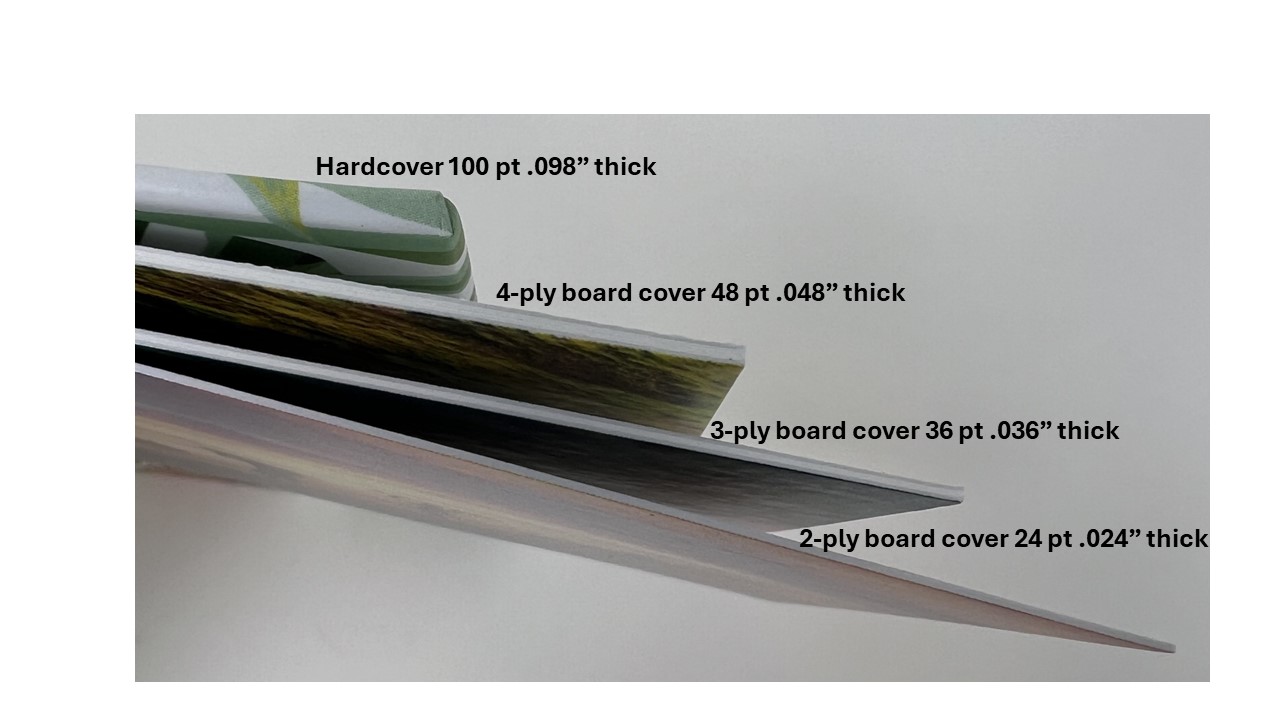
Board Cover Thickness Options: One advantage of board covers is the ability to choose the thickness that best fits the product you are creating.
24 pt (2-ply) Two sheets laminated together. This is a great upgrade from a softcover when you want a little more strength without adding too much bulk. Ideal for notebooks and lighter planners.
36 pt (3-ply) Three laminated sheets create a noticeably sturdier cover. This thickness works very well for planners, journals, and workbooks that will be used regularly.
48 pt (4-ply) Four laminated sheets produce a thick, rigid board that begins to feel comparable to a hardcover. This option works well for premium planners, heavy-use journals, and products designed to last.
Each increase in thickness adds rigidity and durability, so the right choice depends on how the product will be used.
Why Customers Love Board Covers
✔ Durability: The layered construction resists bending and helps protect the interior pages during regular use.
✔ Faster and more affordable than hardcovers: Traditional hardcover books require additional production steps. Board covers provide rigidity and strength while simplifying the manufacturing process, helping keep costs and production timelines lower.
✔ Flexible design options: Board covers work beautifully with planners, journals, notebooks, and workbooks.
✔ Professional finished look: When paired with lamination and specialty finishes, board covers look polished and retail-ready.
Binding Options for Board Covers -- Board covers pair well with several binding styles, depending on how you want the product to function.
Wire-o binding
Plastic or Metal Spiral binding
Disc-bound punching
Lamination and Specialty Finishes: Board covers can be finished in various ways to enhance both durability and visual appeal. Board covers are usually printed using a coated stock, so there is a slight gloss to our standard paper. We can also add additional finishes:
Soft-touch, matte or gloss lamination
Foil stamping
Embossing
Debossing
Round Corners
Choosing the Right Board Cover for Your Project: When selecting a board cover, consider how it will be used.
Daily planners and workbooks often benefit from thicker paper, such as 36 pt or 48 pt. Products that will be carried frequently may also benefit from rounded corners to reduce wear.
Budget and timeline are also important factors. Board covers offer a sturdy, professional look while remaining more affordable and faster to produce than traditional hardcovers.
Finally, consider the finishing details. Lamination, embossing, foil stamping, and binding style all contribute to the overall look and experience of the finished product.
See and Feel the Difference: The best way to understand board covers is to see and feel them in person. Comparing different thicknesses side by side makes it much easier to decide what feels right for your product.
You can order printed board cover samples here. Samples allow you to compare thickness options, finishes, and overall feel before committing to production.
A Practical and Professional Cover Option: Board covers strike a practical balance between durability and affordability. They provide a sturdy, professional cover while keeping production simple and efficient.
For planners, journals, notebooks, and workbooks that will see regular use, board covers are an excellent option that delivers both strength and visual appeal.
 What a Tip-On Photo or Image Cover Actually Is
 What Is a Flip Book?